Africa Desk Political Feature: Zimbabwe’s Power Struggle – The Battle for Control
By Wasse Marlvine
Mnangagwa’s Purge: The Coup Fears and Zimbabwe’s Political Gamble
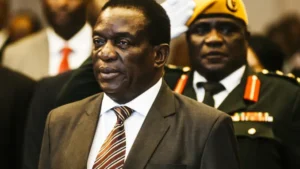
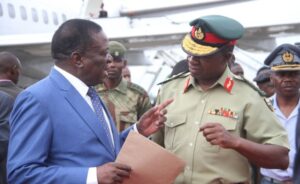
In a move that has sent shockwaves through Zimbabwe’s political and military circles, President Emmerson Mnangagwa has dismissed top army general Anselem Sanyatwe, a decision many interpret as an attempt to neutralize potential threats within the armed forces. The firing of Sanyatwe, a key figure in Zimbabwe’s military hierarchy, signals Mnangagwa’s growing unease about the possibility of a coup orchestrated by disillusioned factions within his administration and the security sector.
Mnangagwa, who came to power in 2017 after ousting longtime ruler Robert Mugabe with military backing, now finds himself in a similar predicament—only this time, the very force that brought him to power may be the one plotting his downfall.
Cracks in Zimbabwe’s Military: A Brewing Storm?
Zimbabwe’s military has always played a decisive role in the nation’s leadership transitions. The removal of General Sanyatwe, once a close ally, raises questions about growing divisions within the armed forces. Reports suggest that elements within the military are frustrated with Mnangagwa’s rule, particularly his handling of the economic crisis, corruption allegations, and his apparent plans to extend his rule beyond 2028.
The Zimbabwe National Liberation War Veterans Association (ZNLWVA), once Mnangagwa’s staunchest supporters, have now turned against him. They are demanding his resignation, arguing that he has failed to address the economic suffering of ordinary citizens and accusing him of betraying the revolutionary ideals of Zimbabwe’s liberation struggle. Some factions of the war veterans are even backing Vice President Constantino Chiwenga as a possible successor—a development that further complicates Mnangagwa’s grip on power.
Zimbabwe’s Economic Crisis Fuels Unrest
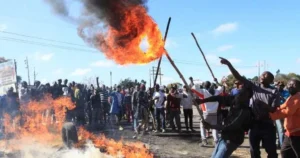
At the heart of this power struggle is a worsening economic crisis. Zimbabwe’s currency continues to plummet, inflation is soaring, and citizens are grappling with shortages of basic goods and services. Many Zimbabweans, including key military and war veterans’ factions, blame Mnangagwa for the country’s economic collapse, arguing that his policies have done little to stabilize the situation.
For Mnangagwa, keeping the military loyal is no longer just about political maneuvering—it is a matter of survival. His recent move to fire General Sanyatwe could either solidify his control or accelerate the cracks within the security establishment, leading to unpredictable consequences.
Is Zimbabwe on the Brink of Another Coup?
The big question now is: Will Zimbabwe’s military take action? While Mnangagwa is using preemptive measures to weaken potential threats, history has shown that military purges can backfire. If key factions within the armed forces feel alienated or threatened, they may decide that removing the president is the only way forward.
Mnangagwa’s rule, which began with promises of economic reform and democratic renewal, now resembles a regime increasingly reliant on fear and suppression. As tensions continue to rise, Zimbabweans find themselves asking: Are we witnessing the beginning of another power shift, or will Mnangagwa outmaneuver his rivals and tighten his grip on power?
AfriScoop will continue to track developments as Zimbabwe’s political crisis unfolds. The battle for control is far from over, and the coming months could determine the country’s future for years to come.